Best time to walk the Hooker Valley Track
Compare Hooker Valley Track weather, seasons, crowds, snow and daylight to choose the best time for your Mount Cook hike.
Walk the Hooker Valley Track between November and April if you want long days and easy walking, and in March or April if you would give up some daylight for fewer people. Winter, from June to August, works with microspikes and poles. No month is dry at Aoraki/Mount Cook, so whichever you choose, keep a spare morning in case cloud hides the mountain.
Check Availability
Which season suits which walker
The track is open all year and free to walk in every season. The daylight, the ice and the number of people change.
| Season | Light and weather | On the track | Who it suits |
|---|---|---|---|
| Summer (December to February) | About 15 and a half hours of daylight in late December. December and January are the two wettest months | DOC says “Icebergs speckle the lake in summer”. The busiest months, with the car park under pressure from 10 am to 4 pm | Walkers who can start at sunrise or after 4 pm |
| Autumn (March to May) | Shorter days; 344 to 380 mm of rain a month | Fewer people once Easter has passed | Our pick, if quiet matters more to you than long evenings |
| Winter (June to August) | Just under 9 hours of daylight in late June | Ice on shaded sections, a lake that can freeze, and a road that snow can close | Walkers with microspikes, poles and a date they can move |
| Spring (September to November) | October is the third-wettest month | Alpine flowers begin; snow and ice can linger | People who come for the flowers and accept changeable weather |
Autumn as the pick is our view. DOC’s White Horse Hill Campground page points the same way: mid-February through to Easter has “generally fewer people”. Do not expect solitude on a fine summer day. DOC says the track draws hundreds of thousands of visitors each year.
In any season, DOC warns, “it’s common to experience strong wind, high rainfall, heavy snowfall and rapid changes in temperature at any time of the year.”
Month by month: rain, light and what is out
The rainfall figures are NIWA’s monthly averages for Mt Cook Village, 1981 to 2010. Spring is not the wettest season, as some guides say: the three wettest months are December, January and October.
| Month | Average rain | What to expect |
|---|---|---|
| January | 423 mm | Long days and often icebergs on the lake. The busiest weeks at the car park |
| February | 260 mm | The least rain of any month. Fewer people from mid-February, by DOC’s campground advice |
| March | 380 mm | The last of DOC’s busy car park months |
| April | 344 mm | Shorter days and a quieter car park |
| May | 365 mm | The visitor centre closes at 4:30 pm from May to September |
| June | 322 mm | The shortest days: about 8:13 am to 5:08 pm on 21 June. Ice on shaded sections |
| July | 265 mm | The second-lowest rainfall. The lake can freeze; stay off it |
| August | 301 mm | DOC says snowfall can limit access to the park from June to September |
| September | 345 mm | Spring begins; snow and ice can linger |
| October | 416 mm | The third-wettest month |
| November | 367 mm | Car park pressure begins. Mount Cook buttercups usually start flowering |
| December | 497 mm | The wettest month and the longest days: about 5:54 am to 9:21 pm on 22 December |
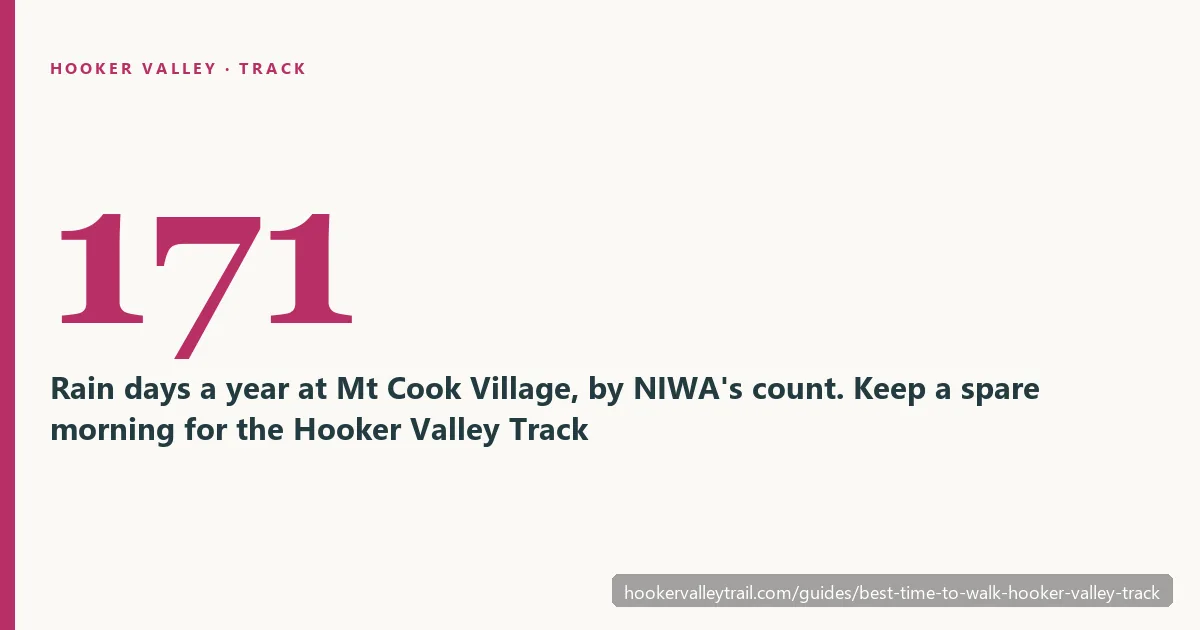
NIWA’s 1991 to 2020 average for Mt Cook is 4,132 mm of rain a year, with rain on about 171 days a year at Mt Cook Village. That is nearly every second day, so pack a waterproof jacket in any month. The daylight times assume a flat horizon; the valley walls hide the sun earlier.
The Mount Cook buttercup (kōpukupuku), which DOC calls the world’s largest buttercup, flowers along the track in early summer, usually from about November into January. Lupins are an introduced plant that flowers beside the roads and lakes of the Mackenzie Basin, roughly from mid-November to late December, so you see them on the drive in and not on the track.
The best hours of the day
From November to March, DOC warns that “White Horse Hill car park may have limited parking spaces from November to March between 10 am and 4 pm.” Turn up mid-morning in January and expect to hunt for a space and walk in a crowd.
Sunrise is the quiet hour: you are parked before the busy window opens, and a calm early morning is your best chance of reflections on Hooker Lake. Late afternoon is the other gap: start after 4 pm in December and you still have about five hours of daylight for a three-hour walk.
Winter turns that advice round. DOC’s Sally Jones says “The best part of the day in winter is often around late morning to mid-afternoon when the sun has warmed things up a bit.” DOC also recommends microspikes and hiking poles for the icy shaded sections: see our winter guide.
Why one spare day is the best plan
Cloud can hide Aoraki completely, even when it is pleasant at the car park. The walk is still good on those days, but nobody can promise you the summit. With rain on about 171 days a year, a single fixed slot is a gamble, and the mountain can stay hidden for a day or more.
Stay two nights if you can, so you have a second morning to try. The night is a bonus: the park lies inside the Aoraki Mackenzie International Dark Sky Reserve, designated in 2012 and covering 4,367 km2. Our where to stay guide lists the options.
What a day tour’s timetable means for timing
A day tour fixes both the date and the hours. On the Cheeky Kiwi day tour from Queenstown, from US$154 per person and rated 4.8/5 from 610+ reviews, you get about three hours at the trailhead in the middle of the day, and the departure time from Mt Cook is fixed. In summer that puts you on the track in DOC’s busy hours. In winter it matches the late-morning to mid-afternoon window DOC recommends.
You cannot wait a day for the cloud to lift, so book a date early in your stay, which leaves room to rebook. Our breakdown of that tour has the timetable, and the tour comparison shows which trips leave the most time on the track.
Checking the forecast and track conditions
Check the park forecast the night before: DOC links NIWA’s from its track page and MetService’s from its park page. DOC also closes the track in heavy rain or high wind: in 2022 it said it “has lowered the threshold for closing the track when heavy rain is forecast”. Our status page explains how to check track conditions on the morning of your walk.
Frequently asked questions
What is the best time of year to walk the Hooker Valley Track?
November to April for long days and easy walking, and March or April for fewer people. Winter works with microspikes and poles.
Can you see Aoraki/Mount Cook from the track?
On a clear day, yes: from the second half of the walk and from Hooker Lake. Cloud often hides the summit.
Are there icebergs on Hooker Lake?
Often in summer, when DOC says they “speckle the lake”. In winter the lake can freeze. Stay off the ice.
About the conditions shown on our homepage
The strip on our homepage shows five things for White Horse Hill car park, where the track starts, at about 760 m above sea level.
Track status is typed in by hand. We read the Department of Conservation’s Hooker Valley Track page and copy what it says, with the date we checked. DOC can close the track or a bridge at short notice, and only DOC decides whether the track is open, so read its page yourself on the morning of your walk.
Temperature, wind and the rain total for the next 24 hours are a forecast for the car park, not a measurement. The forecast is based on data from MET Norway (the Norwegian Meteorological Institute, api.met.no), licensed under the Norwegian Licence for Open Government Data (NLOD) 2.0 and Creative Commons Attribution 4.0 International (CC BY 4.0). We changed the data in three ways: wind is converted from metres per second to km/h, values are rounded, and the hourly rain amounts are added into a 24-hour total.
The forecast is a snapshot. We collect it a few times a day and the strip shows the hour that matches your clock; hover over “About this data” to see when it was last collected. If it has not been refreshed for too long, the strip says “Forecast out of date” and shows no number. It never says whether the track is open or whether a tour is running: for those, ask DOC and your tour operator. The wind figure is the average wind, and gusts in the valley are often stronger. Hooker Lake can be colder and windier than the car park.
Daylight, from sunrise to sunset in New Zealand time, is calculated from the date and the car park’s position with the standard NOAA solar equations. The mountains around the valley hide the sun earlier than the sunset time suggests.
For the official mountain forecast and any weather warnings, see MetService. For road conditions on State Highway 80, see NZTA Journeys.
Next: pick your dates, then check the morning
Choose the season, add a spare morning, and read the full track guide for the turnaround points. If you are driving, the parking guide covers the charges at White Horse Hill. On the day, check DOC’s page before you leave, because closures are posted there first.
Find a Tour That Fits Your Day
The Hooker Valley Track needs no booking and no guide. If you have no car, compare day trips from Queenstown, Lake Tekapo and Christchurch by how much time they leave you on the track.
Check Tour Availability